When we talk about surfing, one of the things that most influences how our board behaves in the water is the fins. Here at Sopelana beach, we’ve seen it all: from students arriving with retro boards to those opting for the latest technology. Let’s dive into the types of surf fins and how they affect your experience in the water.
Fixed vs. Removable Fins
Let’s start with the basics: fixed fins and removable fins. Fixed fins are glassed onto the board, a classic system still seen in specific models. They offer a smoother glide but limit you to a single setup.
- Fixed: Less drag, more stability, but less versatility.
- Removable: More common today, allowing you to change configurations based on sea conditions.
Removable fins, whether FCS or Futures systems, are what we use most in our classes. They let you adapt to the type of wave and surfing style.
Types of Fin Configurations
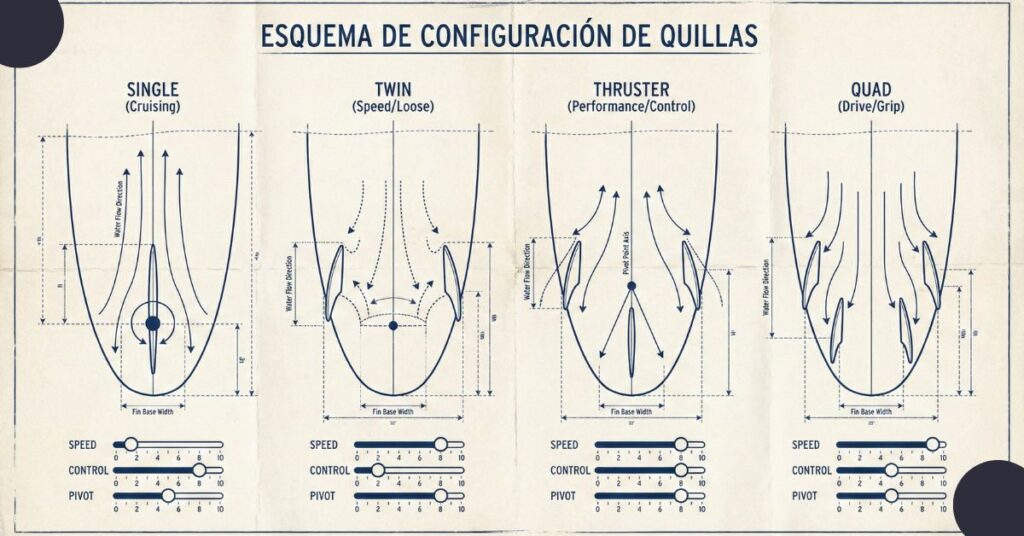
Single Fin
The Single Fin setup is the most traditional and is often seen on longboards. With just one fin, you get stability and control, ideal for surfers seeking a pure line on the wave.
- Stability: Great control in straight lines, but limited in turns.
- Versatility: You can move the fin forward for a looser feel or backward for more control.
Twin Fin
The Twin Fin is perfect for those seeking speed and maneuverability in small waves. The two side fins allow for wide, open turns, ideal for shortboards.
- Speed: Greater speed in small waves.
- Fun: A sliding sensation similar to skateboarding.
Thruster (Trifin)
The Thruster is the most common and versatile setup. With three fins, you get a combination of stability and maneuverability, suitable for both beginners and advanced surfers.
- Stability: The three fins offer perfect balance.
- Options: You can convert it to single or twin according to your preferences.
Quads
Quads are great for those seeking speed and grip in deep turns. With four fins, they channel water towards the tail of the board, providing more acceleration.
- Grip: Greater traction in tight turns.
- Speed: Excellent for small to medium waves.
Bonzer and 2+1
The Bonzer, developed by the Campbell brothers, offers a unique experience with its elongated side fins and a central one. On the other hand, the 2+1 combines a large central fin with two smaller side fins.
- Bonzer: Speed and grip in all types of waves.
- 2+1: Ideal for more dynamic turns.
Alternative Configurations
Hydrofoil and Asymmetrical
If you’re looking for something more alternative, Hydrofoil offers a flying sensation over the water, though it’s more challenging to handle. Asymmetrical boards offer a different fin setup on each side of the board.
- Hydrofoil: For the daring, offers a unique experience.
- Asymmetrical: Innovative and surprising in turns.
Peña Txuri Tip: Before changing fins, make sure you know your surfing style and sea conditions well. Experiment with different setups to find what suits you best.
At our school, we always say that surfing is a combination of technique and adaptation. Paddling and choosing the right fin can make a difference in your water experience.
So now you know, fins are much more than just an addition to your board. They influence how you glide and interact with the wave. Experiment, try, and find what suits you best. And if you have doubts, at Peña Txuri we’re here to help you navigate this sea of options.